Xen Orchestra in a nutshell
Xen Orchestra (XO) is the complete solution to visualize, manage, back up and delegate your XCP-ng (or XenServer) infrastructure: any number of pools, on any site, from one place. No agent is required for it to work. Together with XCP-ng, it forms Vates VMS, the fully open source virtualization stack built and supported by Vates.
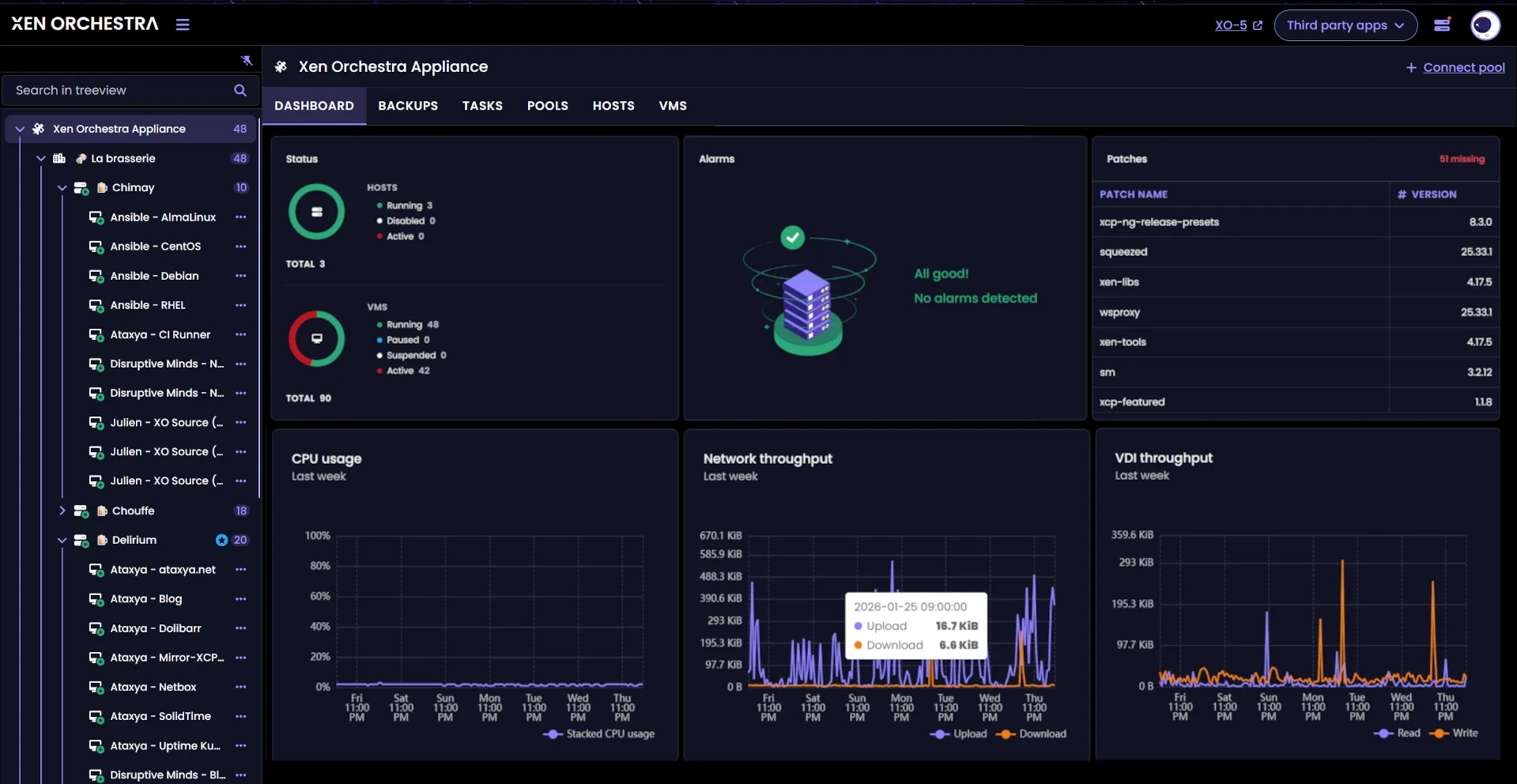
Everything goes through XO, and everything that talks to your infrastructure talks to XO:
Start here
What XO does for you
- Administration: complete control of your pools, hosts, VMs, storage and networks, from a modern web interface or from XO 5.
- Backup and disaster recovery: rolling snapshots, full and incremental backups, replication, mirroring and immutability, toward S3, NFS, SMB or Azure targets. See Backups.
- Migration from VMware: V2V imports your ESXi VMs directly into your pools.
- Automation: a REST API, a CLI, and first-class providers for Terraform, Ansible, Pulumi, Packer and PowerShell, plus Kubernetes cluster recipes.
- Delegation: users, groups and RBAC to give each team exactly the access it needs.
- Scale: one XO manages any number of pools on any number of sites, over LAN or WAN.
XO in the Vates VMS stack
This documentation covers Xen Orchestra itself. Its two siblings cover the rest of the stack, and the three work as one set:
| You are looking for | Where to go |
|---|---|
| Xen Orchestra: the interfaces, the backup engine, the REST API and automation, XOA | You are here |
| XCP-ng: installing and operating the hypervisor, hosts, storage and networks, hardware compatibility | docs.xcp-ng.org |
| The stack as a whole: getting started end to end, bundles and licensing, compatibility ecosystem, security advisories, product roadmap | docs.vates.tech |
The search bar at the top covers docs.xen-orchestra.com, docs.xcp-ng.org and docs.vates.tech at once, with results grouped by product. Wherever a topic lives, searching from here will find it.
Two interfaces, one product
Xen Orchestra currently ships two web interfaces on the same server and the same data: XO 6, the new default interface, and XO 5, which remains available for the operations XO 6 does not cover yet. Read XO 6 and XO 5 to see what lives where.